🌟 Leadership: Mindset, Character & Growth · Jun 2026
Great leadership is not about a title — it is about the mindset shifts you make and the qualities you build over time. This section brings together several powerful frameworks: Indra Nooyi's 6 C's of character, the 15 mindset shifts that define the engineer-to-leader journey, lessons on leading without authority, redefining what success truly means, and daily gratitude and growth habits that compound over time. Together, they form a complete picture of what it takes to lead, communicate, and grow in a fast-changing world.
The 6 C's of Leadership
Inspired by Indra Nooyi — who led PepsiCo for 12 years — these six qualities distil what it takes to lead at the highest level. Her original 5 C's have been extended here to reflect the full depth of modern leadership.
Master your craft deeply — accept where you are today, embrace hard work, commit to continuous improvement, stay prepared to seize more chances as they appear, and always keep moving forward. Competence begins with self-awareness: knowing your strengths and what you still need to learn is the first step to genuine growth. In the modern world, true competence also means building self-regulation — managing your own emotions through restraint, composure, and emotional control.
"Run your race. Trust your pace. Stay humble. Keep moving."
Communicate with clarity, empathy, and authenticity at every level. Adapt your tone to your audience — direct with peers, structured with executives, warm with those who need reassurance. Whenever tension rises — before or during a conversation — use Box Breathing (4 sec in → hold → out → hold) to shift from reacting to listening — empathy lives in that pause.
"Your message is only as good as your audience's understanding of it."
Make tough calls and speak hard truths — courage is acting despite discomfort. Pair it with quiet self-assurance: confidence earned through preparation, not pretence. True courage also means saying "I don't know" when you don't — owning uncertainty is a sign of strength, not weakness.
"Have the courage to act and the confidence to own it."
Show up the same way every day — in your values and standards. Trust is built not through grand gestures but through reliable, predictable actions over time. True consistency demands the ability to endure — to keep showing up through setbacks, hardship, slow periods, and moments when progress feels invisible.
"What you do every day matters more than what you do once in a while."
Lead with a moral compass — know your values, stay consistent under pressure, and always do what is right for people and planet, not just profits.
🙏 Gratitude is a quiet superpower: pausing to appreciate your team, your growth, and your opportunities sharpens perspective and fuels resilience. Feel blessed for the people who challenge you, the work that stretches you, and every chance you get to lead.
"Profits with purpose — business must be a force for good."
The willingness to self-correct — and create a culture where others can too. Great leaders acknowledge mistakes early, adjust course without ego, and treat feedback as data, not criticism. Each correction is an act of self-improvement: the leader who iterates on themselves sets the standard for the whole team.
"The fastest path forward is the one where you admit you were wrong and change direction."
Growing from Engineer to Leader: 15 Mindset Shifts
The technical skills are necessary but not sufficient. The real transition happens in how you think. These 15 mindset shifts define the leader's way of seeing every problem:
| # | Mindset | One-liner |
|---|---|---|
| 1 | Business first, tech second | Every decision traces back to a business reason |
| 2 | Pricing & monetization thinking | Understand how the business makes money before designing |
| 3 | Question the design | Ask Why? 3 times before accepting any requirement |
| 4 | End-to-end thinking | Never design in isolation — own the full chain: CRM → CPQ → BRM → RevRec → GL |
| 5 | Design for scale | Ask "What breaks at 10x volume or 3 new markets?" |
| 6 | Prevent defects, don't fix them | Catch failures at design stage, not go-live |
| 7 | Trade-off thinking | Best decision given constraints beats perfect decision never shipped |
| 8 | Own the data flow | Follow every field from source to journal entry |
| 9 | Speak every stakeholder's language | CFO hears risk, developer hears patterns, sales hears capability |
| 10 | Communication is the architecture | Best design is worthless if nobody understands or follows it |
| 11 | Future-proof without over-engineering | Design for likely change, not every possible change |
| 12 | Auditability by default | Every rupee must be traceable — design reconciliation in, not after |
| 13 | Embrace ambiguity | Unclear requirements are not a blocker — they are your work |
| 14 | Reuse before you build | Every customisation is a debt paid at every upgrade |
| 15 | Think in contracts between systems | Define what each system promises to the next |
Leadership Without Authority & Building Trust
Most senior contributors influence through credibility and relationships, not org-chart power. Trust is earned through consistent, visible good judgment — not seniority or title.
- Build credibility before you need it. Deliver on commitments consistently — so you are listened to when it matters.
- Make your reasoning visible. Show the alternatives you rejected and why. A decision the team understands is one they own and defend.
- Ask before prescribing. "What would you do differently?" surfaces blind spots and often produces better answers.
- Give credit publicly, correct privately. Making your team look good builds loyalty no salary can buy.
- Be honest when uncertain. "I don't know — let me find out" builds more trust than a confident wrong answer.
Grit, Grace & Growth Mindset: A Framework for Resilience
Three concepts build on one another to form a complete approach to overcoming obstacles and achieving continuous personal development.
Perseverance and passion for long-term goals. Grit is what keeps you moving when motivation fades — the stubborn commitment to finish what you started, even when progress feels slow or invisible.
"It's not about how hard you hit — it's about how hard you can get hit and keep moving."
The emotional intelligence to handle failure with empathy and humility. Grace is how you carry yourself through setbacks — without blame, without bitterness, with the composure to learn and move forward with dignity.
"Strength is how you handle success. Grace is how you handle failure."
Growth mindset is the belief that abilities can be developed through dedication — every challenge a learning opportunity, every failure data, every skill something that can be built. Hope is what makes that growth worth pursuing: the active conviction that the future can be better, and the quiet fuel that keeps you beginning again.
"Hope is not passive. Hope is getting up and doing something." — Jane Goodall
Redefine What Success Means to You
Society teaches us to measure success by job title and salary alone. But leaders with a strong moral compass know that a fuller, more sustainable definition of success spans eight dimensions — and that financial health is just one slice of a much richer pie.
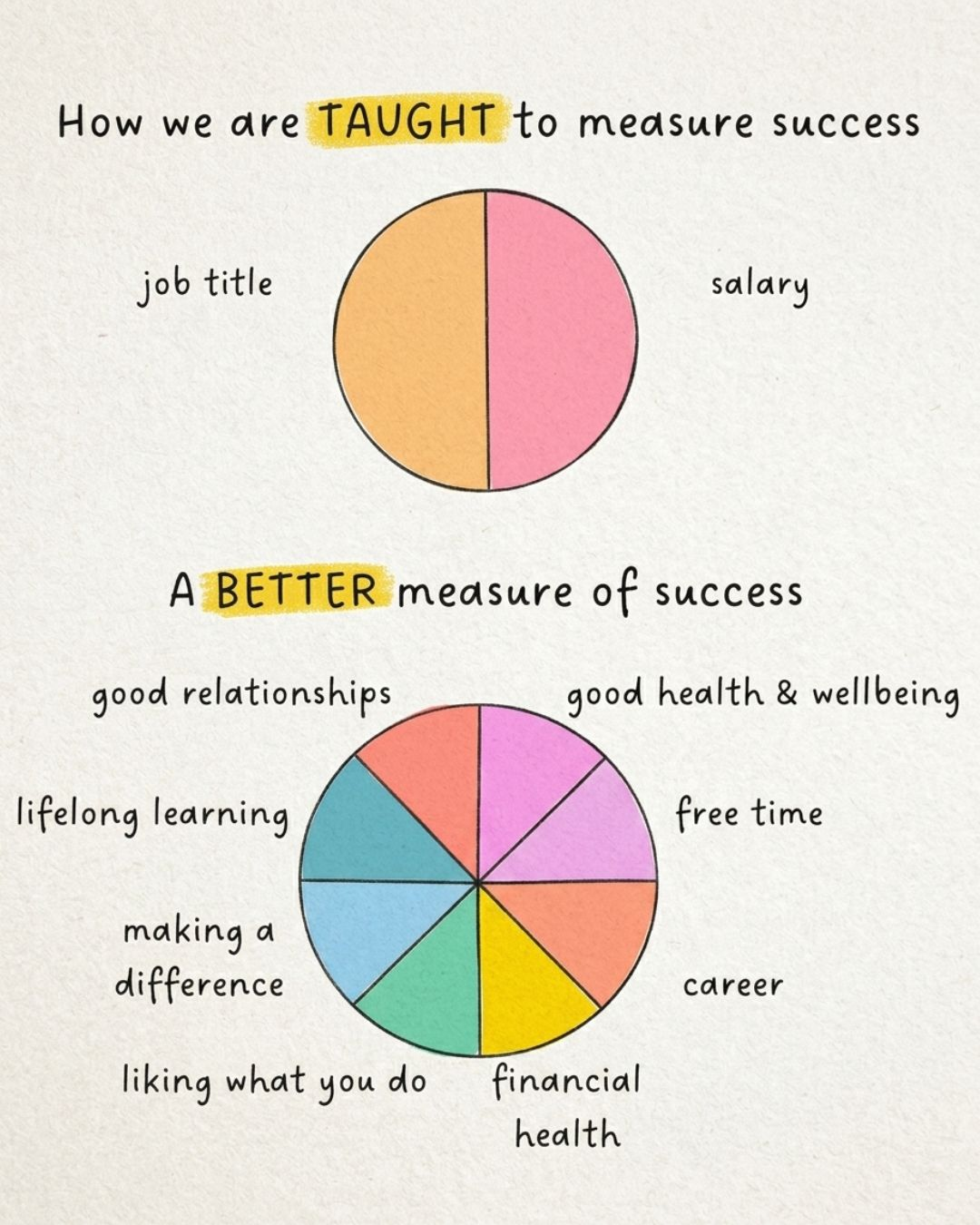
As you grow from engineer to leader, keep checking in on all eight dimensions — not just the two the outside world celebrates. A leader who neglects health, relationships, or lifelong learning eventually runs dry and has nothing left to give the team.
A Mantra for the Work
If the C's, the mindset shifts, and Grit-Grace-Growth had to compress into one line to carry in your pocket, it would be this — humility to keep learning, endurance to keep going, judgment to choose well, and mastery through detached, skillful action.
Yogaḥ karmasu kauśalam
skill in action, undivided by outcome
Humble — to keep learning
Endure — to keep going
Judge — to choose well
Master — through detached, skillful action
To remember it: H-E-J-M — like "hedge 'em." Hedge your life with all four, and you're covered whatever comes.
🎧 How to Become an Effective Communicator: Listening, Asking, and Articulating · Jul 2024
Communication is 55% body language, 38% tone, and only 7% the actual words — the so-called Mehrabian principle. Being an effective communicator means mastering all three channels, not just what you say.
Active Listening: The Skill Most People Skip
Most people listen to reply, not to understand. Active listening means engaging with the full message — words, tone, and intent.
- Focus 100%. Put down your phone. Make notes if it helps you stay in the conversation.
- Put yourself in their shoes. Think about how the receiver will interpret the message, not just what you meant.
- Whether they like detail or summary. Some people want the full picture; others want the headline. Read the cue.
- Paraphrase and summarise. Reflect back what you heard: "So what you're saying is…" This checks understanding and shows you were listening.
- Ask open-ended questions. "How are you feeling about this project?" opens dialogue. "Is everything fine?" closes it.
- Engage in the conversation. Nod, use short affirmations ("I see", "Go on"), and resist interrupting.
The CURR Listening Model
CURR is a four-step cycle for deep, disciplined listening. Each step builds on the last — miss one and the whole loop breaks.
Articulation Skills: How You Deliver Matters
Art and music share a quality: the best communicators vary their delivery the way music varies tempo and volume. Monotone kills engagement.
Body Language: 55% of Your Message
The six non-verbal signals that audiences read constantly:
The Power of Questions
Questions are the steering wheel of any conversation. The right question at the right moment changes outcomes.
✅ Open-ended (use more)
- "What are your thoughts on…?"
- "How would you approach…?"
- "What's getting in the way?"
- "How are you feeling about X?"
⚠️ Closed (use sparingly)
- "Is everything okay?"
- "Did you finish the task?"
- "Are you happy with the plan?"
Business English: Asking for Clarification & Email / Meeting Etiquette
Asking for clarification is a sign of engagement, not ignorance. Use these professionally:
- Intro → Body → Closing
- Warm greeting before the ask
- Active listening phrases in replies
- Close with next step or action
- Summarise long threads before replying
- Set context early
- Priority-order your items
- Don't talk too long — be concise
- Summarise decisions before hanging up
- When we can talk — be available
Self-Esteem & Confidence: The Foundation of Good Communication
Communication skills are amplified — or undermined — by how you see yourself. High self-esteem makes you:
Four Human Skills AI Cannot Replace
- Learn the tools. AI competency is no longer optional in many fields. Build fluency with the tools your industry is adopting — it multiplies every other skill you have.
- Build communication skills that travel. The ability to explain complexity clearly is becoming a multiplier across roles. It does not matter how good your ideas are if you cannot get others to understand and act on them.
- Strengthen judgment-based skills such as leadership, ethics, prioritisation, and client management. Those are difficult to automate because they depend on context — and context is something only humans bring to the table.
- Do not underestimate the long-term value of skilled physical work. In a digital economy, tangible competence stands out. Craft, precision, and hands-on expertise will remain irreplaceable.
🎯 The Art of Persuasion: How to Win Hearts, Minds, and Meetings · Jan 2025
Persuasion is not manipulation — it is the ability to present your ideas so compellingly that others genuinely want to act on them. From ancient Greece to modern boardrooms, the same three pillars hold: Ethos, Pathos, and Logos.
The Three Pillars of Persuasion
Speaking Styles: Know Your Audience
Different audiences respond to different tones. Adapt your style:
Conversational Rituals That Build Influence
Small habitual behaviours that compound into strong professional presence:
- Share credentials early. Briefly reference relevant experience before making a recommendation — credibility reduces resistance.
- Exchange pleasantries before diving in. A short warm-up lowers defences and opens minds.
- Give feedback in private. Public correction triggers shame; private feedback triggers reflection.
- Don't be judgemental. Focus on data and behaviour, not character. "The deadline was missed" vs. "You're irresponsible."
- Give sincere compliments. Specific, genuine praise builds goodwill and primes reciprocity.
- Personal authority — project calm confidence through posture and measured speech.
Storytelling: The Most Powerful Persuasion Tool
Facts tell, stories sell. A well-structured story is processed 22× faster than raw data. Use the Beginning → Middle → End structure:
② Middle: What did you/we do? What obstacles arose?
③ End: What was the outcome? What did you learn?
The Power of Silence
Silence is an advanced persuasion tool. After asking an open-ended question, pause and wait. Silence after asking is rarely destructive — it signals that you expect a thoughtful answer. Most people will fill the silence with exactly the information you need.
✅ Silence is helpful
- After an open-ended question
- After making an important point
- When emotions are running high (de-escalate)
❌ Silence is disruptive
- When someone is already answering
- During time-critical discussions
- When the listener needs reassurance
Reinforce Your Idea: Connect Emotionally and Be Authentic
Persuasion fails when the audience senses insincerity. Three habits that keep you authentic:
💼 Speak Like a Manager: Business English That Gets Results · Jul 2025
The words you choose at work shape how others perceive your authority and competence. Switching from casual English to professional Business English is not about sounding formal — it is about being precise, clear, and credible in every interaction.
The Manager Mindset: Four Core Responsibilities
Before the words come the priorities. A manager communicates with purpose around four pillars:
Every message — email, meeting, status update — should map back to at least one of these. If it does not, question why you are sending it.
Upgrade Your Vocabulary: Casual → Professional
Small swaps make a large difference in how polished you sound:
Power Words: Adjectives That Add Weight
Replace weak or vague modifiers with words that carry authority:
Pair them with adverb intensifiers when you need to emphasise:
How to Disagree Politely — Without Burning Bridges
Professional disagreement is a skill. The goal is to stand your ground while keeping the relationship intact.
✅ Do
- Acknowledge before pushing back: "I hear you, but…"
- Use soft openers: "I'm afraid I don't see it that way."
- Offer alternatives: "What if we considered…"
- Validate their viewpoint: "Your perspective is valid, but I think…"
- Close gracefully: "Let's agree to disagree."
❌ Don't
- Make personal attacks
- Dismiss outright: "That's wrong."
- Take a break without signalling
- Go on the defensive immediately
Simple Expressions That Signal Emotional Intelligence
Short, memorable phrases that show maturity in communication:
🏛️ Solution Architect Mindset: Think in Systems, Not Components · Jan 2026
A solution architect is not just a senior engineer who draws diagrams — they are a translator between business intent and technical reality. The mindset shift from individual contributor to architect is as much about thinking patterns as it is about system design depth.
Think in Systems, Not Components
Architects see the whole before the parts. A developer asks "how do I implement this feature?" — an architect asks "what problem does this solve, and what does it touch?"
The Trade-Off Mindset: How Architects Make Decisions
There is no perfect architecture — only the best fit for current constraints. Good architects make decisions visibly and document the reasoning so the team can challenge or evolve it later.
② What constraints are non-negotiable? (compliance, team size, existing stack)
③ What does each option cost — now and in 2 years?
④ Who needs to live with this decision? (ops, developers, customers)
⑤ What is the rollback plan if we are wrong?
Communicating Architecture: Speak to the Audience, Not the Diagram
An architecture that cannot be explained is an architecture that will not be followed. Tailor your communication layer by layer:
Saying No — The Most Important Architect Skill
Architects who cannot say no end up with an architecture shaped entirely by stakeholder requests. Every "yes" to a shortcut is a "yes" to future maintenance cost. But a flat "no" kills collaboration. The skill is in how you say it.
✅ How to say no constructively
- "Yes, we can do that — here is what it costs."
- "That will work short-term. Here is the long-term risk."
- "We can skip this safeguard if you accept this monitoring."
- "Let's timebox it to one sprint — review before we go further."
❌ What not to say
- "That's a terrible idea." (shuts down dialogue)
- "We can't do that." (gives no path forward)
- "It violates best practices." (no context)
- Saying yes and hoping it works out.