"Learnbillsoft's vision is to be the go-to resource for mastering Billing & Revenue Recognition within the broader Quote-to-Cash lifecycle — delivering practical, high-quality training for both functional and technical professionals."
Revenue Recognition Training | ASC 606 & IFRS 15
Master the complexities of revenue recognition standards ASC 606 (US GAAP) and IFRS 15 (International). This training provides comprehensive understanding of the 5-step model, practical application in billing systems like Oracle BRM, Zuora Revenue, and NetSuite, and ensures compliance with modern accounting standards. Whether you're a finance professional, billing system administrator, or business analyst, this course bridges accounting theory with technical implementation.
Course Overview
| Training Program | Revenue Recognition Fundamentals & System Implementation |
| Standards Covered | ASC 606 (US GAAP) | IFRS 15 (International) | 5-Step Revenue Model |
| Duration | Variable - Based on depth (Fundamentals: 5-6 Hours | Advanced: 10-12 Hours) |
| Mode | 100% Online | Live Instructor-Led (👤 One-to-One / 👥 Corporate Batch) |
| Target Audience | Revenue Accountants, Controllers, BRM/Billing Consultants, Business Analysts, Finance Teams, System Administrators |
| Other Concepts Covered | Basic accounting knowledge (debits/credits, journal entries), familiarity with financial statements |
Understanding ASC 606 & IFRS 15
| ASC 606 (US GAAP) | IFRS 15 (International) |
|---|---|
| Issued by FASB (Financial Accounting Standards Board) | Issued by IASB (International Accounting Standards Board) |
| Effective since January 1, 2018 | Effective since January 1, 2018 |
| Applies to U.S. public and private companies | Applies to companies using IFRS globally |
| Both standards are substantially converged | |
The 5-Step Revenue Recognition Model
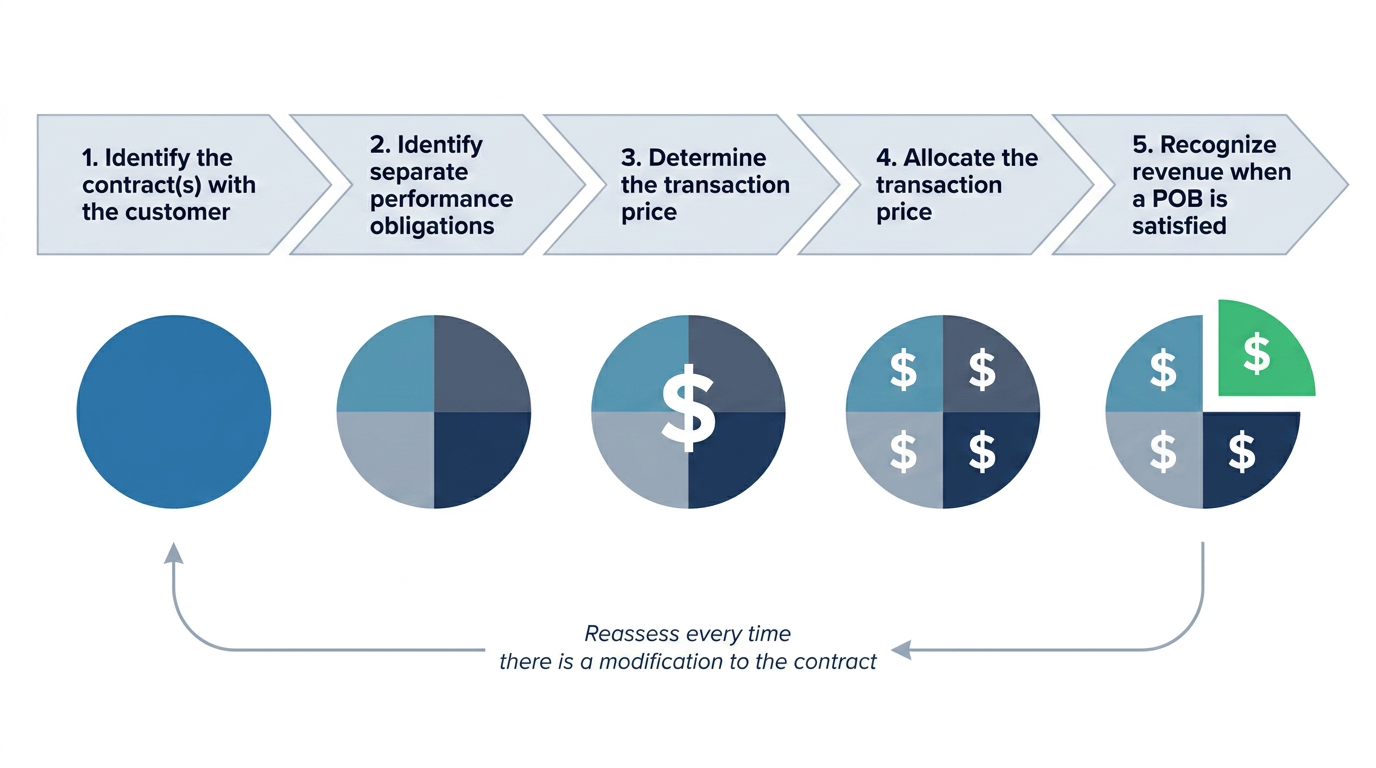
Comprehensive Training Syllabus
Modular approach - customize based on your needs
| Module | Topics Covered |
|---|---|
| 1 |
Accounting Principles for Revenue Recognition
Accrual vs. cash accounting, Debits & credits refresher, Journal entries basics, Balance sheet vs. income statement impact, Matching principle, Deferred revenue as a liability
|
| 2 |
Revenue Recognition Fundamentals
Introduction to ASC 606 & IFRS 15, Historical context, Key definitions, Impact on various industries
|
| 3 |
The 5-Step Model Deep Dive
Contract identification criteria, Performance obligation analysis, Transaction price determination, Allocation methodologies, Recognition timing
|
| 4 |
Complex Scenarios & Edge Cases
Variable consideration, Significant financing components, Contract modifications, Returns & refunds, Warranties, Non-cash consideration
|
| 5 |
Subscription, Telecom & Utilities Revenue
Subscription revenue recognition, Multi-element arrangements, Professional services with subscriptions, Usage-based billing, Credits and promotions, Device sales with service plans, Bundled offerings, Loyalty programs, Installation fees, Network & roaming revenue
|
| 6 |
System Implementation (Billing Platform Agnostic)
A/R feed configuration, GL export setup, Revenue recognition rules engine, Deferred revenue tracking, Custom revenue schedules — concepts apply across Oracle BRM, Zuora, RevStream, NetSuite & similar platforms
|
| 7 |
System Implementation (Oracle BRM, Zuora Revenue & RevStream)
Oracle BRM: opcodes & A/R feed • Zuora Revenue (RevPro): performance obligation setup, SSP configuration, waterfall reporting • RevStream: contract & schedule management, revenue waterfall, GL posting • Contract modifications workflow across platforms
|
| 8 |
Practical Application & Case Studies
Real-world scenarios, Journal entry examples, Month-end close procedures, Revenue reconciliation, Audit preparation, Troubleshooting
|
Industry-Specific Applications
| Industry | Key Challenges | Revenue Recognition Focus |
|---|---|---|
| SaaS/Software | Multi-year contracts, professional services | Ratable recognition, deferred revenue |
| Telecommunications | Device subsidies, bundled services | Allocation, point-in-time vs. over-time |
| Media & Entertainment | Licensing, royalties, content | Rights-based recognition, variable consideration |
| Utilities | Usage-based billing, prepayments | Performance obligation satisfaction over time |
| Manufacturing | Long-term contracts, warranties | Over-time recognition, contract modifications |
Why Learn Revenue Recognition?
Revenue recognition expertise is highly valued. Companies need professionals who understand both accounting standards and billing system implementation.
ASC 606 and IFRS 15 compliance is mandatory. Organizations need experts to ensure accurate financial reporting and avoid audit issues.
Unique skill set bridging finance and technology. Ability to configure billing systems for revenue recognition is in high demand.
What You Will Learn
- Apply the 5-step revenue recognition model to various contract scenarios
- Identify and evaluate performance obligations in complex arrangements
- Calculate and allocate transaction prices using appropriate methods
- Determine timing of revenue recognition (point-in-time vs. over-time)
- Handle variable consideration, constraints, and contract modifications
- Configure billing systems to automate revenue recognition
- Prepare accurate journal entries and reconciliations
- Generate compliant financial reports and disclosures
📞 Interested in Revenue Recognition Training?
Contact us to discuss course details, customization & scheduling